


The first ball of the over is delivered and the batsman gets into a beautiful position, sending the ball racing to the boundary. It’s a disastrous start to the over for the bowler and now he’s under pressure. This over could have a huge impact, swinging the momentum of the match.
That first ball feels like it could have a decisive impact upon the rest of the over. But are we over-thinkings things here? Is the first ball of an over really that decisive? In this article, I’m looking to study exactly that, seeking to answer the question: how much is the first ball actually worth by the time the over is finished?
IPL Scoreboard Impact
For my investigation here, I’ve used a dataset that includes ball-by-ball data on every IPL match played to date. I excluded Super Overs, incomplete overs and the relatively small number of overs that began with a wide or no ball.
What I’m left with is those overs where the first ball represented a genuine, legal delivery. My analysis takes into account some 45,168 completed regulation overs.
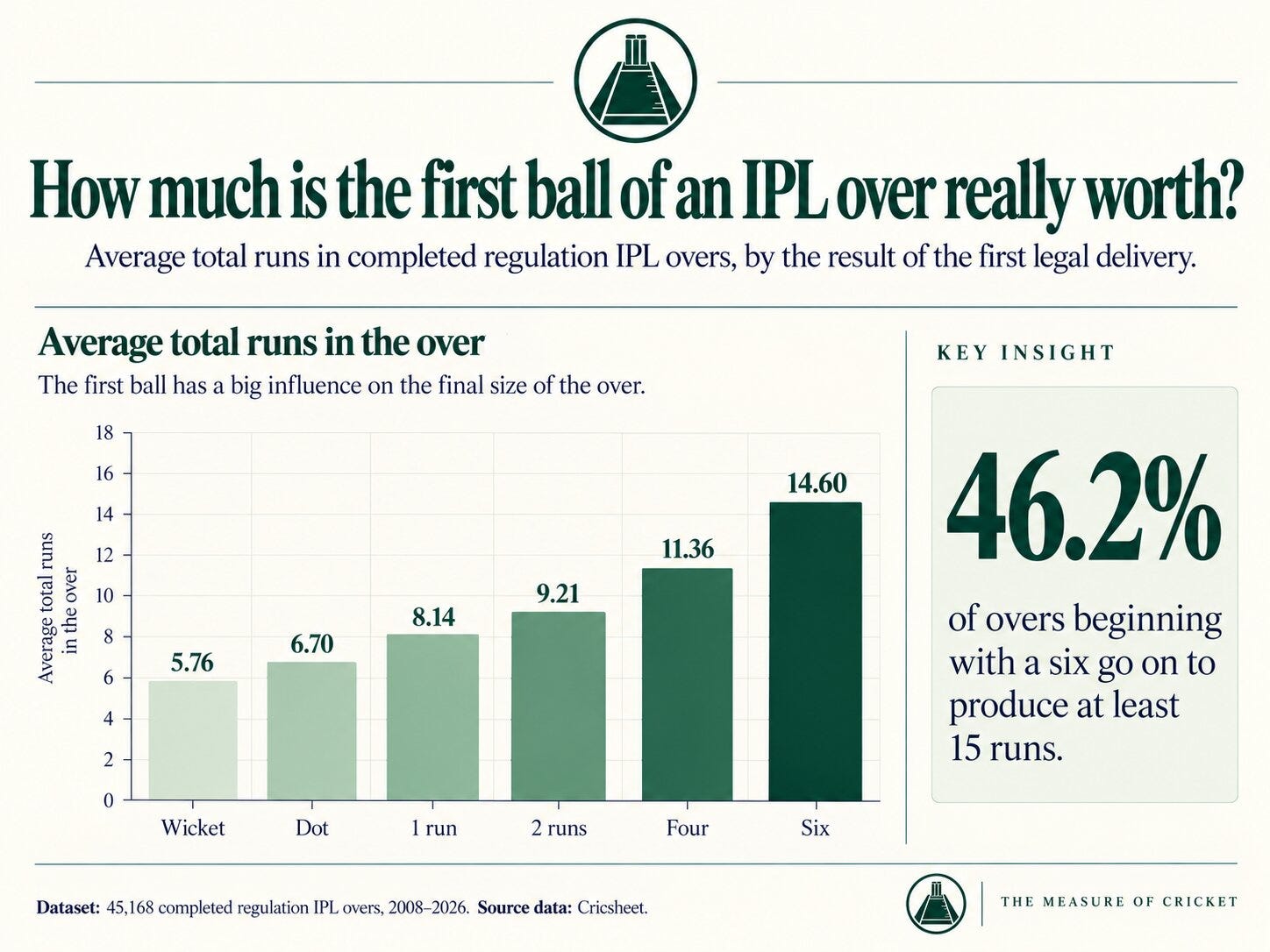
As we can see, there is a huge correlation between the outcome of ball one and the number of runs scored in the over as a whole. That’s perhaps not too surprising and we can see that when the first ball of an IPL over is a six, almost half of those overs go on to produce at least 15 runs.
Compared with an over beginning with a dot, an over beginning with a six scores 7.90 more runs on average: 14.60 versus 6.70. But there’s an obvious point to make here: six of those additional runs have already happened. Our interest is more in the remainder of the over. What happens next?
Does A Good First Ball Have An After-Effect?
If we strip out the first ball and then look at the remainder of the over, we see the following:
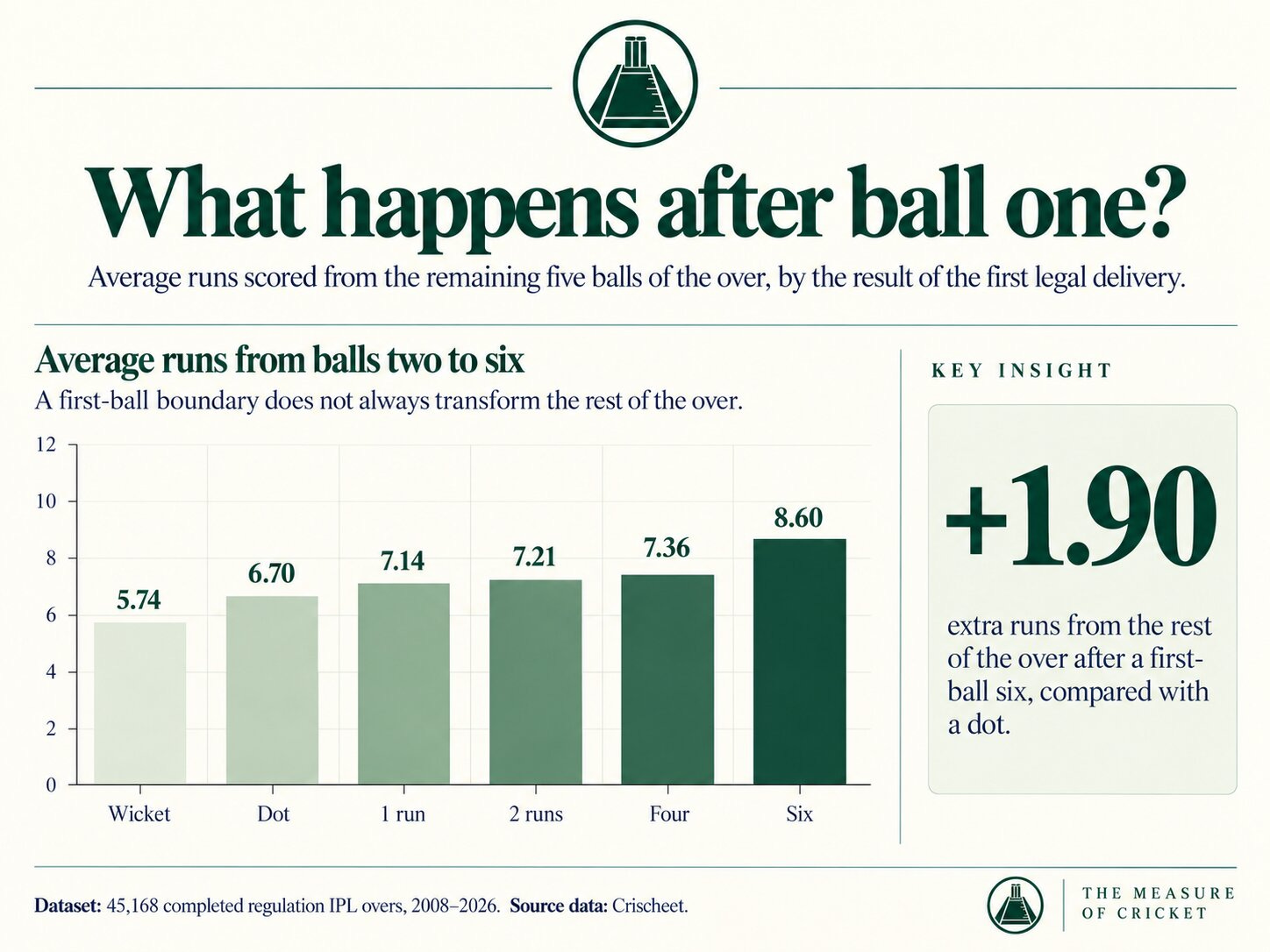
After a first-ball four, the remaining five balls produce only about 0.66 runs more than they do after a dot. After a six, however, they produce 1.90 runs more.
This is interesting. A six off the first ball appears to boost momentum for the batting side. It occurred to me, however, that some of this will certainly be about the match circumstances.
We are more likely to see a six occurring during a higher scoring phase of the match. To take an obvious example: sixes occur more often at the death of an innings. So is that skewing my results somewhat?
Controlling For The Match Situation
It’s clear that what I need to do here is to control for the match situation. In order to do this, I compared overs in similar situations, matching for innings, exact over number, wickets lost at the start of the over and scoring era.
Having done that, I was able to look at how many runs were scored in the remainder of the over, versus what would have been expected if the first ball had been a dot ball:
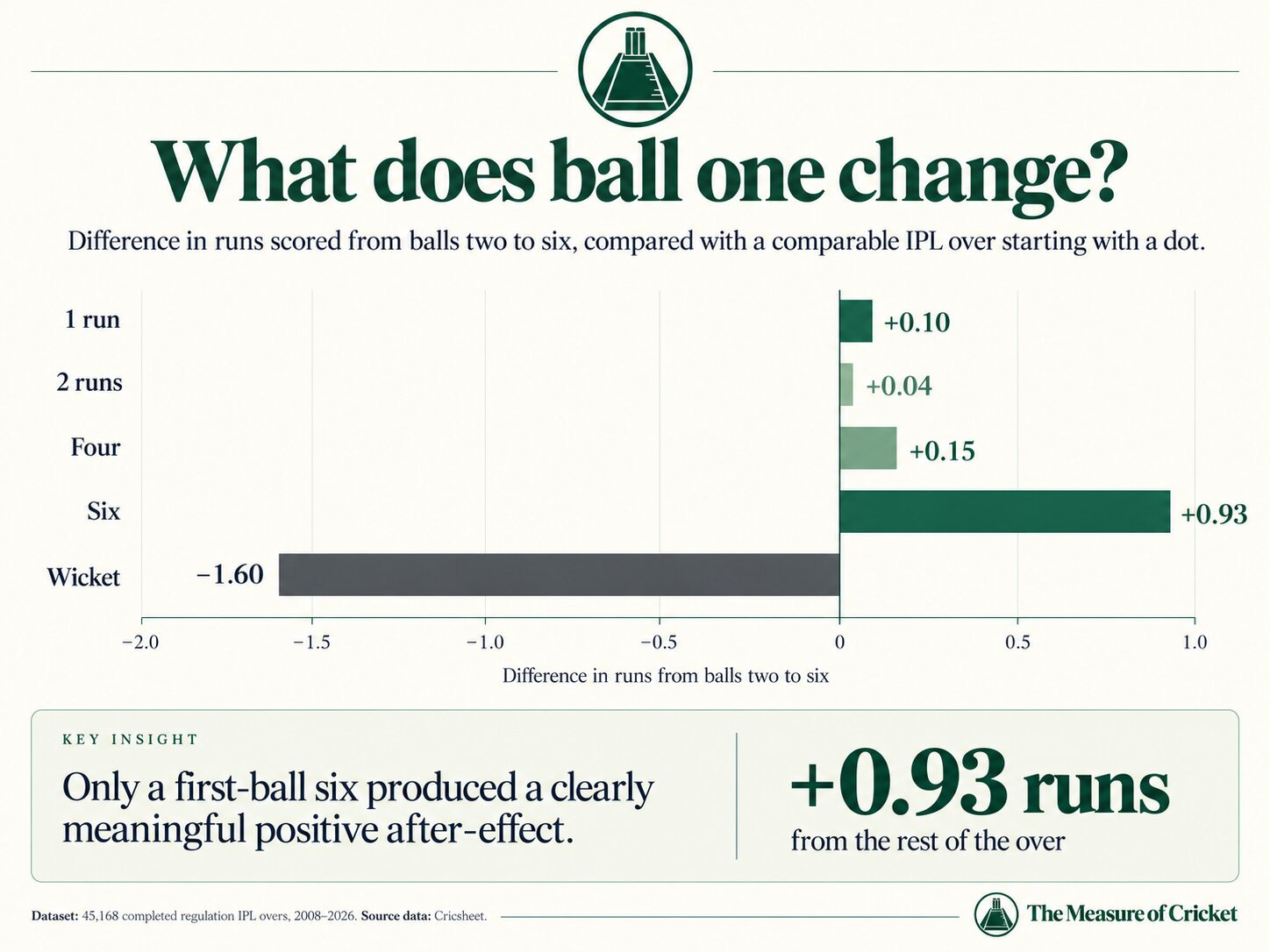
This takes a little interpretation. What the tables shows us is that, if the first ball of the over goes for one, two or even four, then the impact on the runs flowing from the remaining balls of the over only marginally changes.
But it’s different in the case of a six: it adds almost an extra run across the remainder of the over, plus the six itself of course.
A four on ball one is basically worth four runs. There is little evidence that it suddenly unlocks the rest of the over. The six, however, does appear to unlock an additional run (on average) within the same over.
The other interesting element shown in the table is the impact of a wicket from that first ball. The remaining deliveries in the over are then producing 1.6 fewer runs that would have been expected from the first delivery resulting in a dot ball. Perhaps not surprising, but interesting to see it quantified.
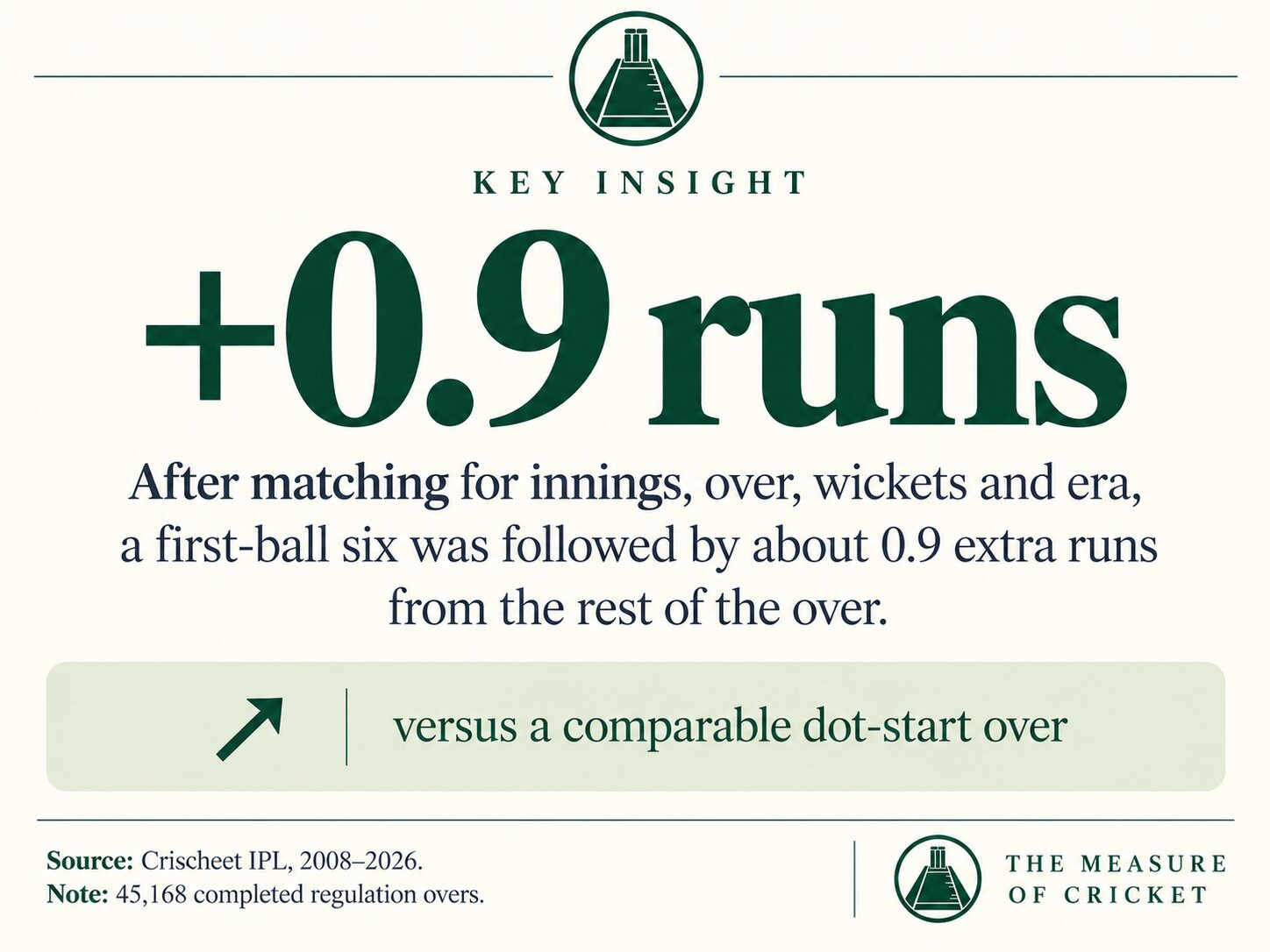
When you next sit down to watch a match in the IPL, keep a close eye on the first ball of each over. A six may be worth more than it seems, while a four doesn’t necessarily lead to a huge scoring boost through the remainder of the over. At least, that’s what the data shows us.