

You are probably aware of the expression that “one wicket brings two”. It seems to be universally accepted within the cricketing world that there’s a higher likelihood of wickets falling in quick succession.
The logic behind this would appear to make sense too: As a stand is broken, the new batsman might take a while to get used to the conditions. The fielding side are on a high and momentum suddenly appears to be shifting. There is a sudden vulnerability about the batting side and an increased chance of another wicket falling in quick succession.
So that’s the established theory. But does it hold up to scrutiny? Let’s take a closer look:
Is A Wicket More Likely To Fall Within The Next 6 Balls?
My starting point was to review all Test Matches played since December 2021 and to ask the simple question: once a wicket falls, is another wicket more likely to fall within the next 6 legal deliveries? Or, at least, has this proven to be the case over the past 25 years or so?
Before answering that, I wanted to establish a baseline. Within any 6 legal deliveries, what chance is there of a wicket falling anyway?
Having studied almost 900 Test Matches, I found that there is an 11.27% chance of a wicket falling within any 6-ball period.
But does that chance increase soon after a wicket has fallen?
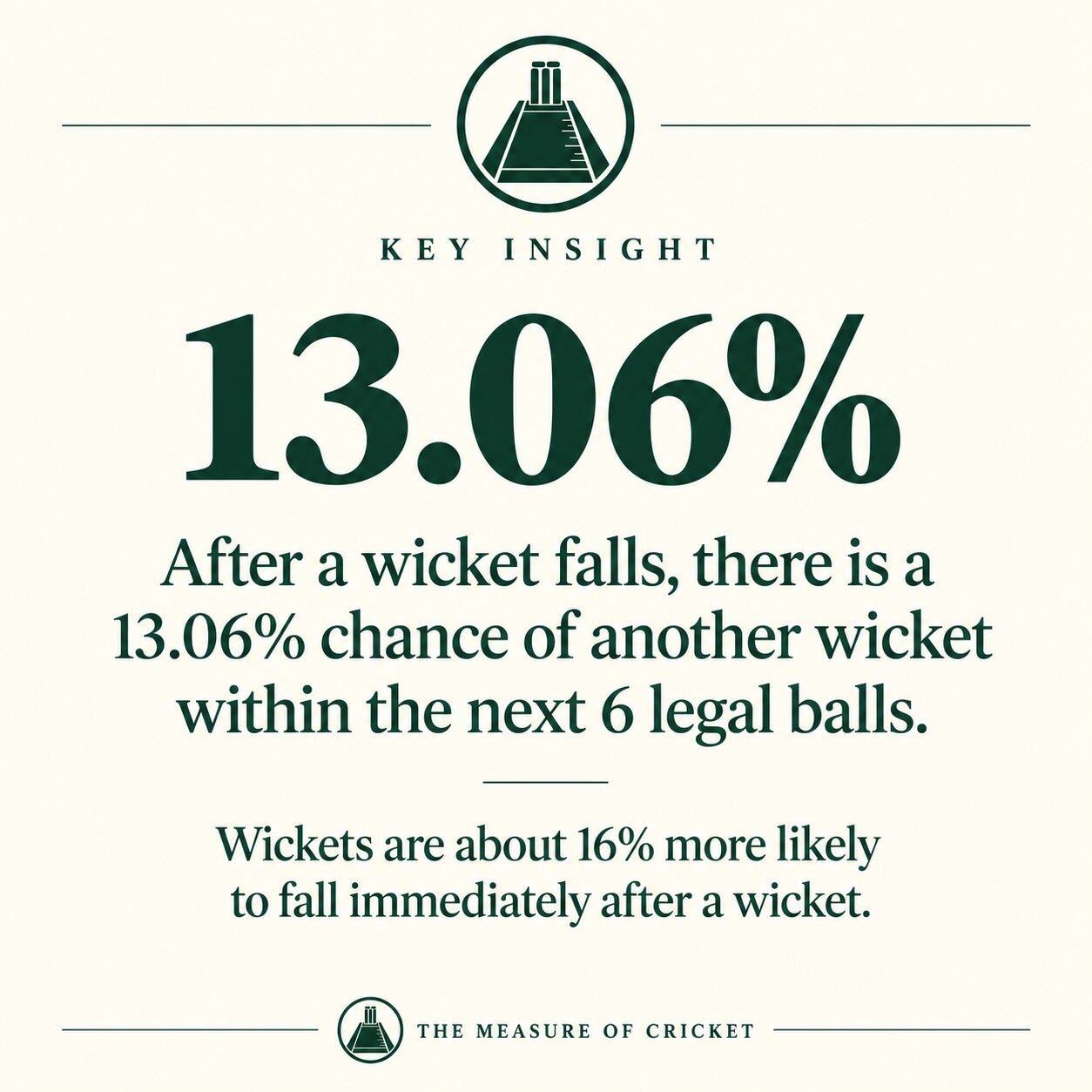
My analysis found that there was indeed an increase in the likelihood of this: following a wicket, a further wicket followed 13.06% of the time within that 6-ball period.
So we can see that there was a difference of 1.79 percentage points. Or, to put it another way, another wicket was around 16% more likely immediately following a wicket.
But, as ever, it can feel like an answer only brings more questions!
What About Beyond Those Next 6 Balls?
What about within the next 12, 18, 24 or 30 balls?
My initial analysis was based upon looking at the 6 legal deliveries immediately following the fall of a wicket. But, when we talk about one wicket bringing two, are we always suggesting that the next wicket will fall within the space of just a few deliveries? Maybe, but I appreciate that some of us may be allowing for a few overs, rather than just a few balls.
Not wishing to disappoint, I have re-run the analysis to look at what happens over the next 12, 18, 24 and 30 balls, with findings in the table below (including the finding above based on the next 6 balls):
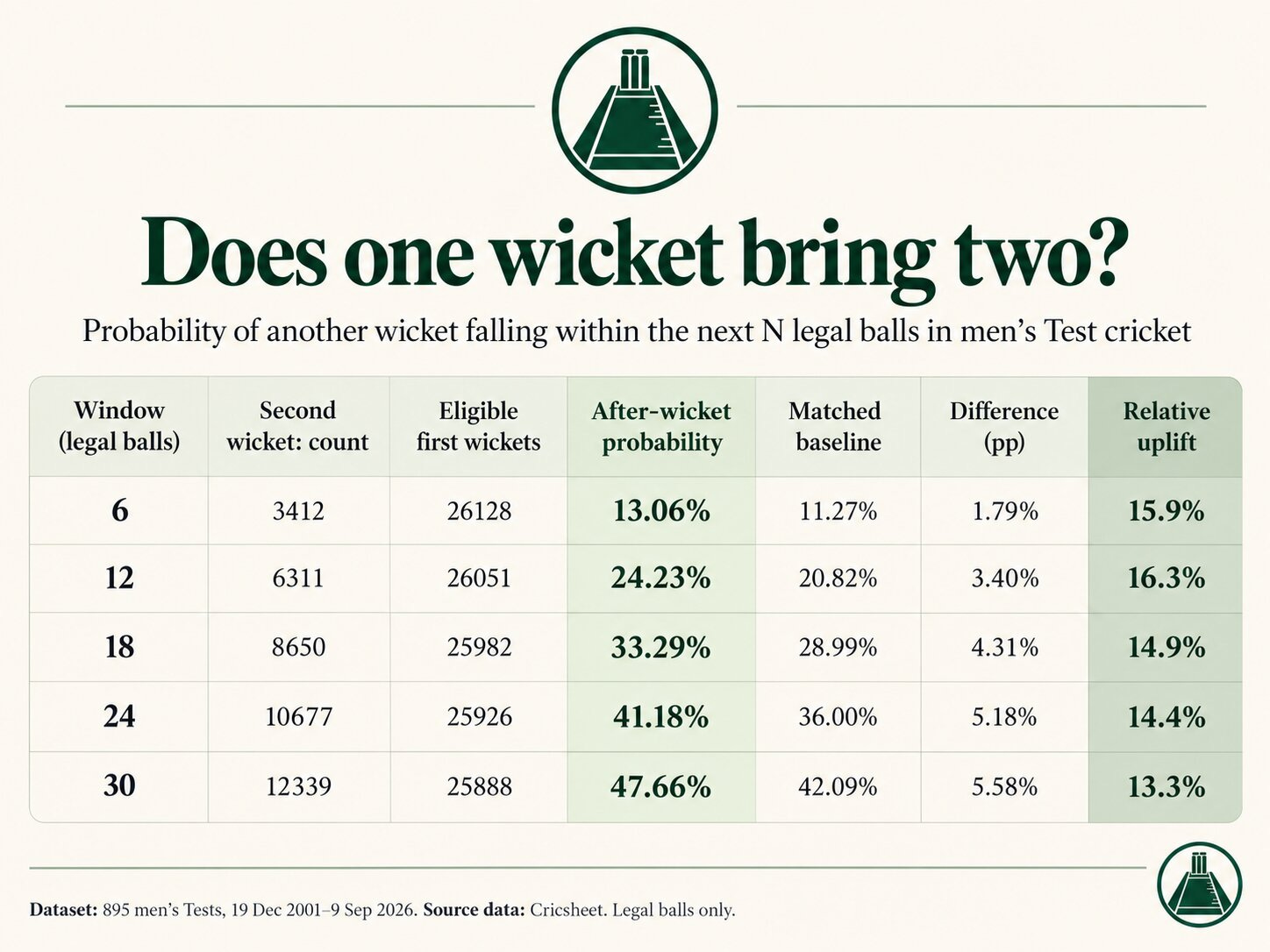
Does one wicket really bring two? On the basis of what we can see above: undoubtedly yes!
There was, however, another element that was nagging at me somewhat here: is one wicket more likely to bring two lower down the order? In fact, might tailenders be skewing the results somewhat?
In the circumstances, there was only one thing to do: I re-ran the analysis to take into account when in the innings wickets were falling. I separated out the fall of wickets 1-3, 4-6 and 7-9. I couldn’t look at the fall of the 10th wicket, of course, since that would be unable to bring about the fall of a further wicket.
I also needed to remove the circumstances where the fall of another wicket wasn’t possible (due, for example, to declarations or matches coming to an end).
Here’s what I found, when looking at whether a second wicket fell within 6 legal deliveries of the first wicket:
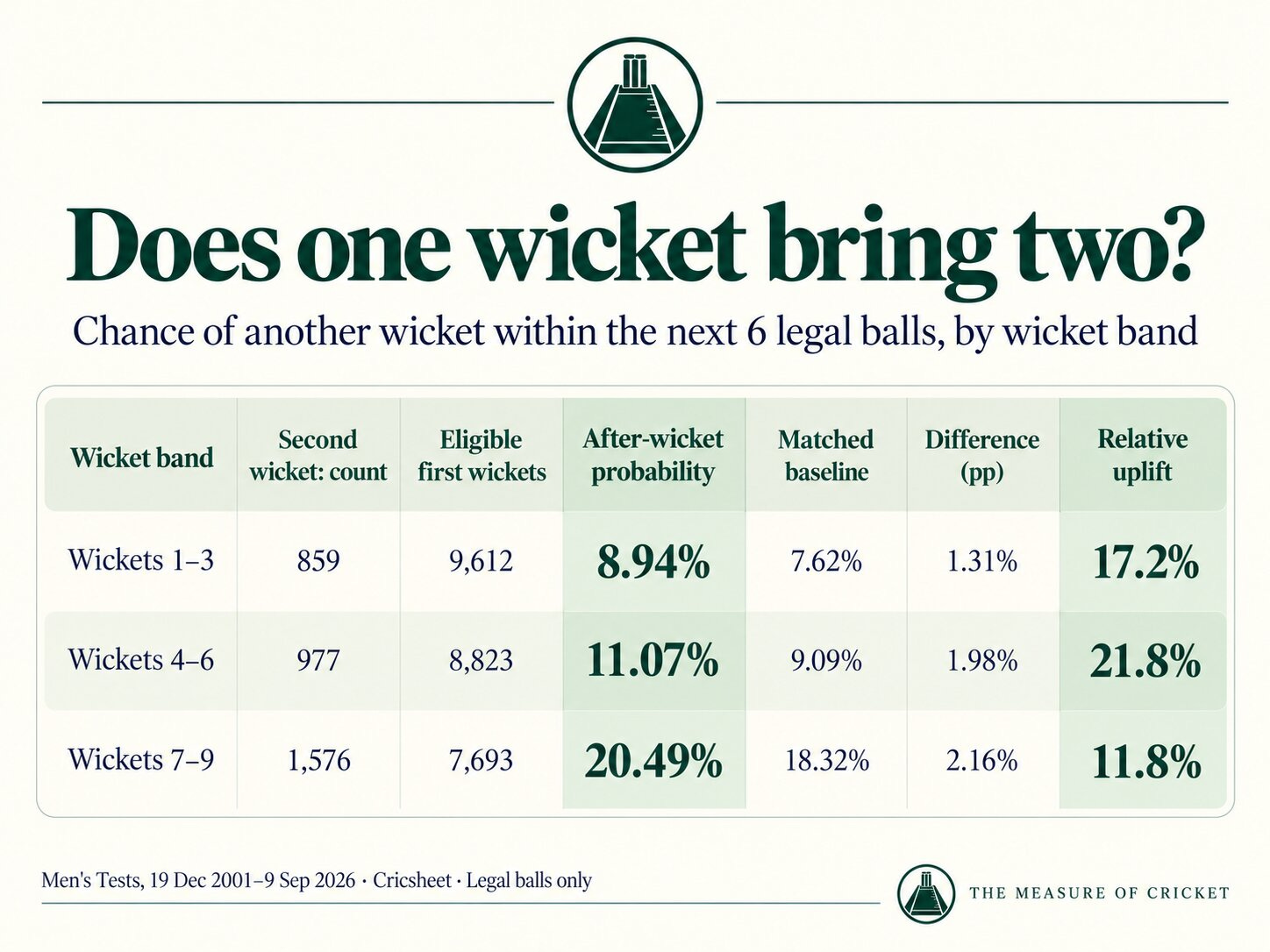
When one of the first 3 wickets falls in an innings, the chances of a further wicket falling within the next 6 legal balls is 8.94% (against a baseline expectation of 7.62%). So there’s a relative uplift of 17%.
When a top order batsman gets out, there’s an increased chance that a further wicket will fall within those next 6 balls.
Interestingly, when we look at the loss of wickets later in the innings, we can see that there is an increased chance of a second wicket falling in quick succession, but that the uplift isn’t quite so significant. For wickets 7-9, the possibility of that second wicket within 6 legal deliveries stands at 20.49%. Crucially, however, the uplift here is only 11.8%.
What Can We Conclude?
Is this widely accepted piece of cricketing wisdom backed up by the data? My analysis suggests that a second wicket is around 15.9% more likely to fall within the next 6 legal balls after the initial loss of a wicket.
When I extended the analysis further, I found that there was a 16.3% uplift on the chances of a second wicket falling within the next 12 legal balls after the initial loss of a wicket. Those first 12 balls seem to be the real danger zone. There’s no doubt, on the basis of these findings, that one wicket is more likely to bring a second within quick succession.
Top order wickets are, if anything, more notably lost in clusters than those lower down the order.
The analysis confirms that there certainly is wisdom associated with this particular saying!
If you’d like to understand more about the analysis approach, then full details are given below.
Notes From Beyond The Boundary: My Analysis Approach
We’re fortunate to live in a period of time when we have great access available to cricket data. Especially Test Match cricket data. My starting point here has been to narrow down my analysis to look at men’s Test Matches played in the past 25 years.
The dataset, in full, allows me to see how frequently the loss of one wicket was soon followed by another. Specifically, I’ve looked at whether a wicket fell within the next 6,12, 18, 24 or 30 legal balls.
There are some complications around this approach:
Firstly, when we look at scorecards, we occasionally see that someone has retired hurt. For the purposes of this analysis, I’ve assumed that a batsman who has retired hurt, or retired not out, is excluded from the fall of wickets.
In doing so, I did consider that there was some scope for dispute on this point: what if the batsman had retired hurt as a result of being struck by a fired up fast bowler, for instance? Might it be said that the fall of the first wicket had encouraged that bowler to bowl with more effort, inspired by the change in momentum? Possibly so, but scorecards don’t reveal the circumstances behind such retirements, which would make it difficult to judge.
Then, there is my choice to limit to legal deliveries. I felt that this was more straightforward, although I do accept that some might suggest that it would skew findings a little.
On balance, however, I believe this analysis approach to be robust.