

I feel like the “Bazball” era of English cricket divided people into two camps: there were those who loved the freedom with which the England team played and those who’d like to have seen a bit more of what might be termed proper cricket. There wasn’t much of a middle ground.
It was certainly the case that it could be infuriating to see a batsman hooking successfully one ball and slashing wildly the next. Sometimes it could be said that he’d simply got carried away. But is this true? If a batsman hits a boundary, then are they actually more likely to get out the very next ball?
In this article, it’s my intention to test this very theory.
What Does The Data Show Us?
For my initial analysis, I decided to take a look specifically at men’s Test cricket. My current favourite dataset allows me to look in detail at all Tests played over the last 25 years or so, giving me a very decent sample size. Happily, this is also a period when we have seen the number of boundaries scored in Test cricket increasing. Has that increase been mirrored by players getting out the very next ball?
I first looked at what happened after a batsman had scored a four. How likely was he to get out the very next ball? Well, the finding was interesting:

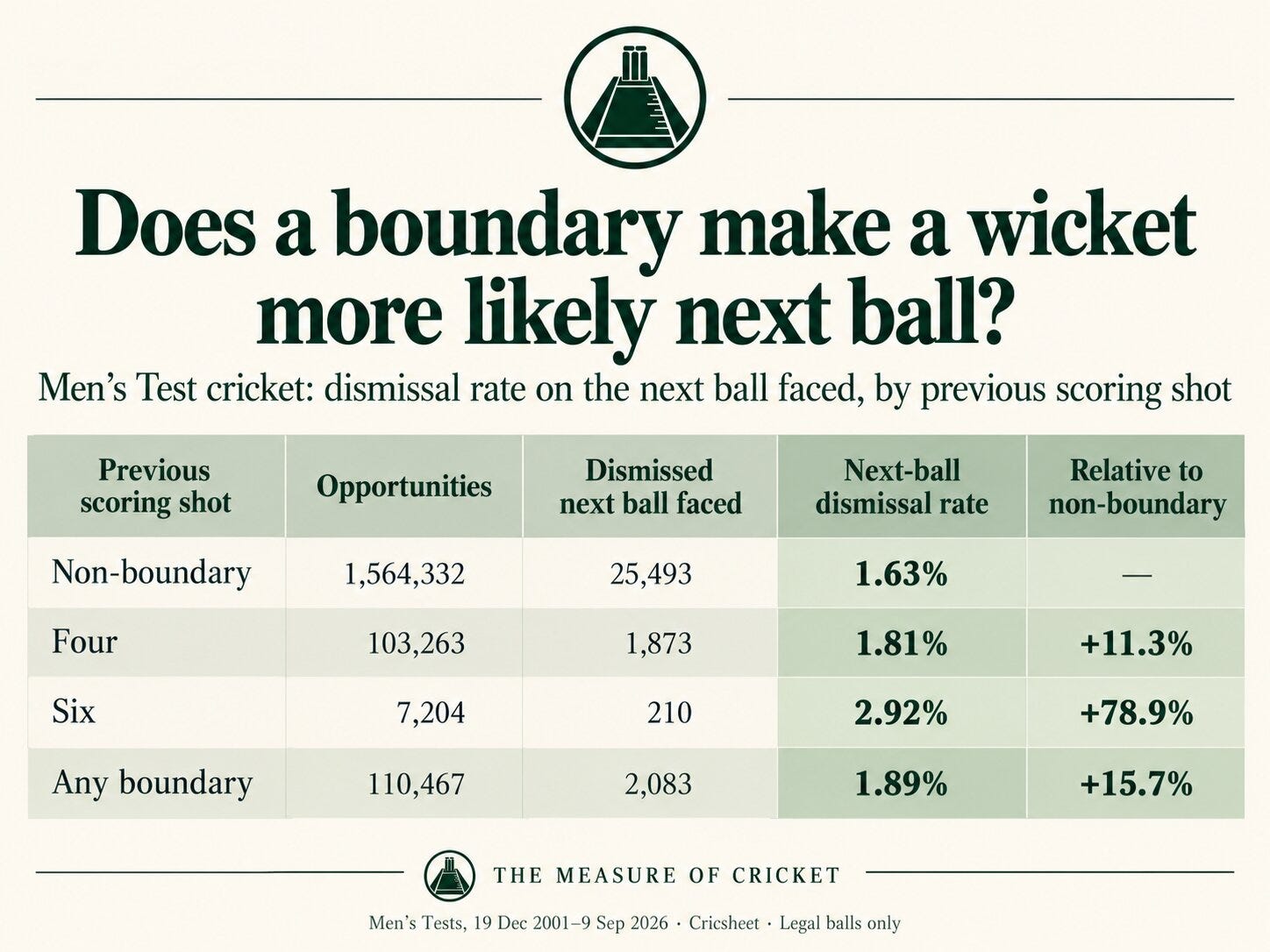
After hitting a four, there’s a 1.81% chance of the batsman getting out the very next ball. It’s important to put that into context: this means that there’s an 11% higher chance of getting out after a four than after a shot that hasn’t resulted in a boundary at all.
So if a batsman hits a four, then we can immediately see that they appear to have an increased chance of getting out the next ball. We might see some sense in that too: it’s possible that adrenaline has got the better of them and that their judgement will be less reliable when facing that next ball. More charitably, perhaps they are having to try and score quickly because of the match circumstances.
What About Sixes?
But that’s only what happens after a four has been hit. We’re not here just for the fours, of course – it’s the sixes that we want to know about! Here’s what my analysis shows here:

I found the result here to be pretty striking. If a batsman hits a six, then their chances of getting out to the very next ball are uplifted by an astonishing 79% (when compared to a delivery where they had failed to hit a boundary). Wow!
Looking at the last 25 years or so of Test cricket, 210 batsmen have hit a six one ball and then found themselves getting out to the very next delivery. I wonder how many were caught in the deep? That’s for an investigation another day!
Providing An Answer
If we combine fours and sixes, then we can definitively answer our original question: does hitting a boundary really make you more likely to get out next ball?
In combination, I found that:
· When a batsman fails to score a boundary, there is a 1.63% chance of them getting out next ball
· When they do score a boundary, their chances of getting out next ball rise to 1.89%
When a batsman hits a boundary, we see a 15.7% uplift in their chances of getting out next ball. Which perhaps explains why more than 2,000 batsmen have fallen in such circumstances in the past 25 years or so of Test cricket.
That boundary might feel great in the moment, but it can be an indicator of trouble in the very immediate future. Especially if your last shot happened to clear the boundary ropes!
You can see my summary data below:
The Measure of Cricket uses data and analysis to test cricket’s conventional wisdom, explain patterns in the game and examine the decisions players and teams make. If you’d like to read more, then you can become a subscriber.