


Modern batsmen love to be hitting the ball. They are less inclined to play in a defensive manner and they get easily frustrated. The increasing dominance of white ball formats within the international calendar means that batsmen are less equipped to dig in when playing in Test cricket.
One of the greatest frustrations for a modern batsman is being unable to score a single run off an over. The maiden over helps to apply pressure, making a wicket more likely.
What I have set out there is a fairly straightforward piece of cricketing wisdom: a maiden over increases the chances of a wicket falling within the next few balls. That’s the wisdom, but does it actually hold true?
Testing The Data
In order to look at this in more detail, I started out with my beloved database of Test matches, covering the past 20 years or so. I looked specifically at maiden overs, excluding wicket-maidens (as I didn’t wish to muddy the waters). What did I find? Here’s a table showing the raw data:
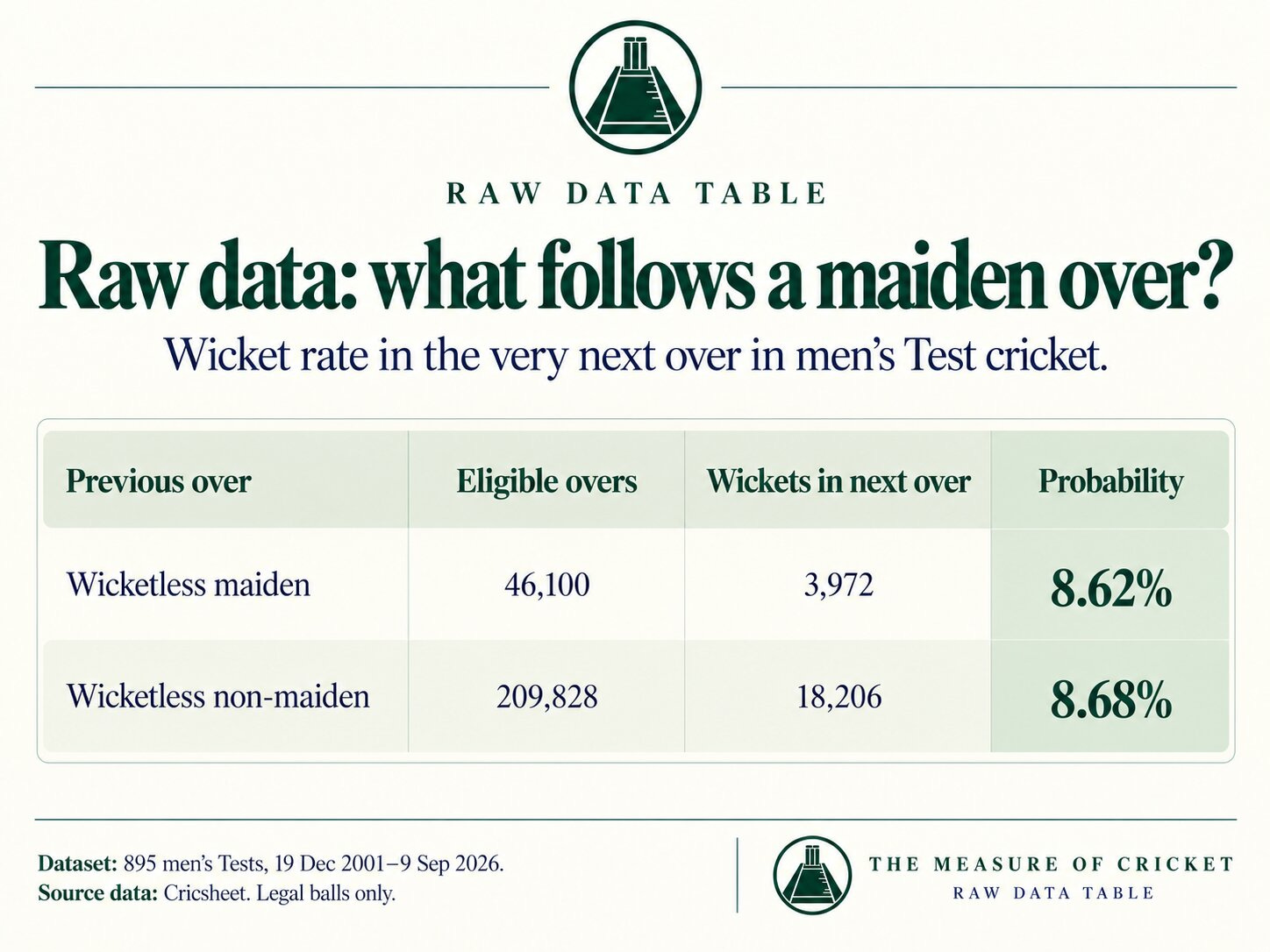
After a maiden over, the probability of another wicket falling in the very next over stands at 8.62%. As we can see, following a maiden over, the probability of another wicket falling in the next over stands at 8.68%. The difference there is so small as to be meaningless: there is no sign at all, within the raw data, that a maiden over is more likely to be followed by a wicket within the next 6 balls.
Is that finding surprising? Inevitably, we all tend to have preconceptions about what we might expect to see. It seems strange to think that a maiden over isn’t increasing the pressure in any way. But maybe a wicket is more likely to fall within the next couple of overs? Is there a delayed effect that I’m missing?
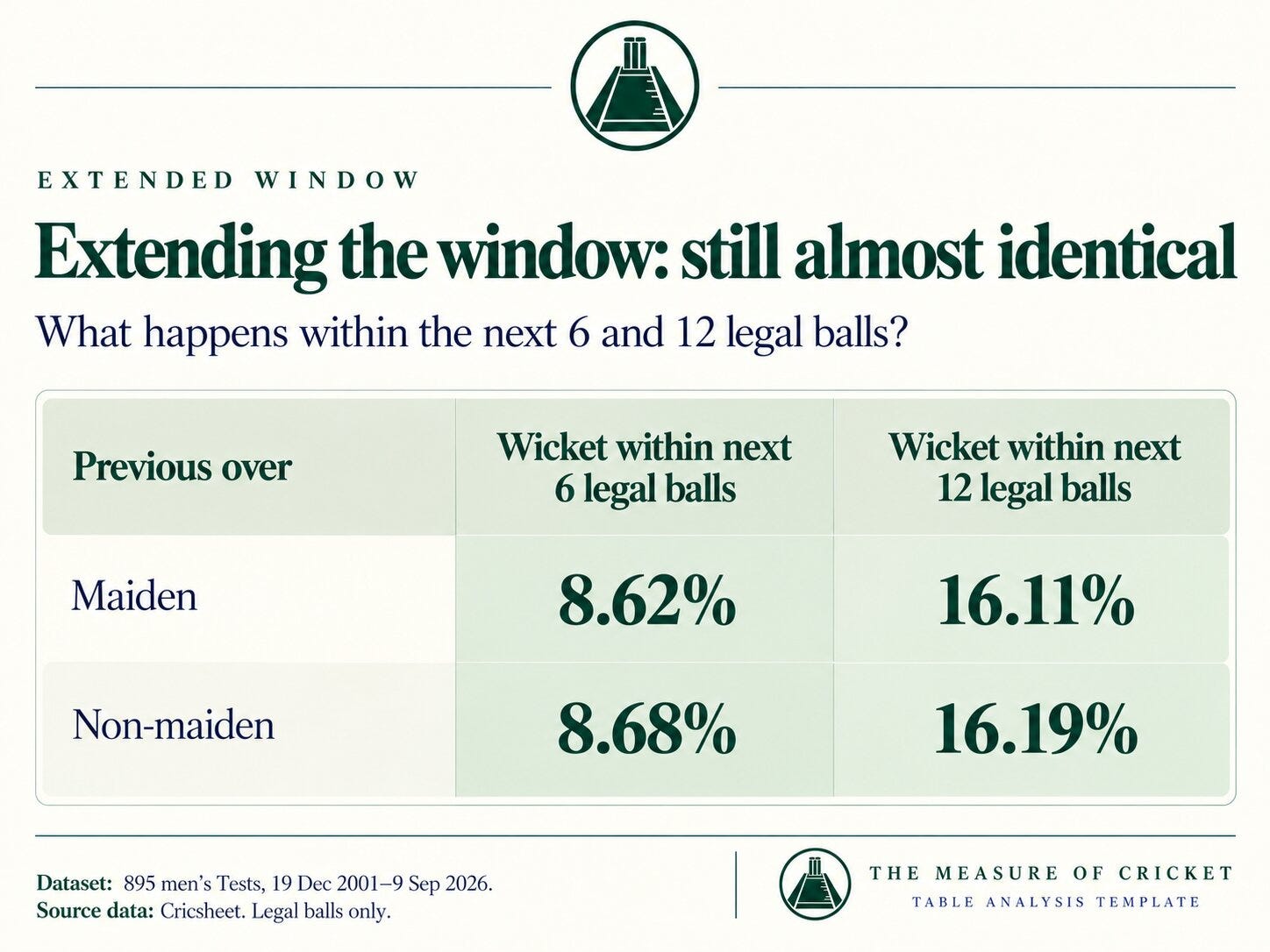
As the graphic above shows, extending the window to include the next 12 balls makes no real difference. In fact, the probabilities shown above are remarkably similar.

Does The Bowler Reap The Rewards?
Perhaps it is the bowler who bowls the maiden over who is more likely to later reap the rewards? That would certainly make some sense: the batting team are struggling to get him away for runs, with the bowler building confidence. It does feel like a wicket is more likely to follow. So I took a look at this too:

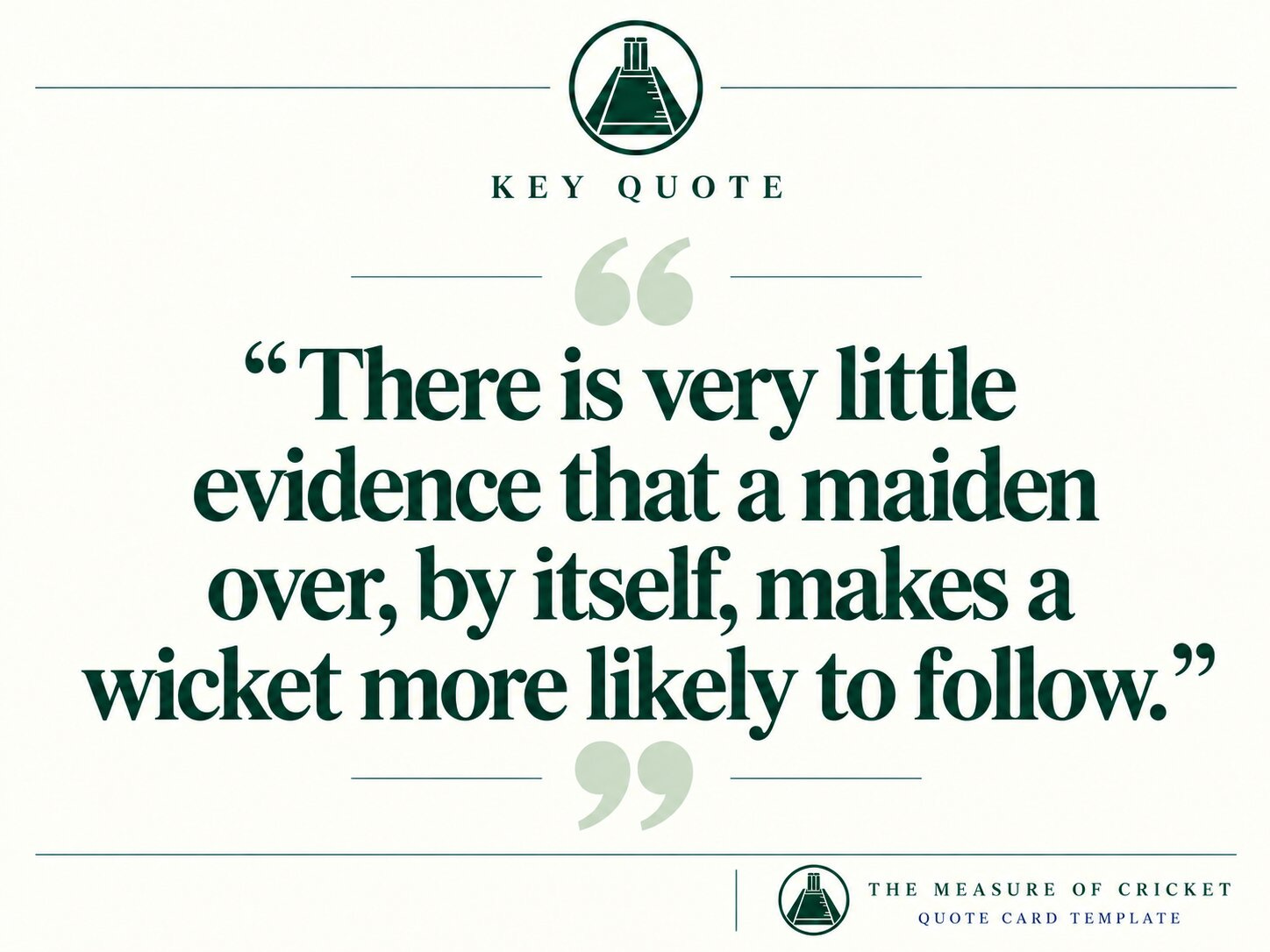
Again, there is no obvious effect.
After a maiden, the bowler took a wicket in their own next completed over 8.55% of the time. After a wicketless non-maiden, the equivalent figure was 8.66%.
So the bowler who applies the supposed pressure does not appear to benefit either.
At this point, my main finding seems to be that a maiden doesn’t increase the chances of a wicket falling anytime soon.
Isn’t It The Pressure Caused By Multiple Maiden Overs?
Is my analysis fundamentally flawed? I’ve considered whether a single maiden over makes a wicket more likely to fall, but isn’t it the pressure caused by multiple maiden overs that would cause a difference?
As the batting team are pinned down, each passing over might increase the chances of a wicket falling. A single maiden over may not produce any obvious pressure, but as those maidens mount up, it does seem likely that the chances of a wicket are increasing.
So I specifically looked at what happens when there have been multiple maiden overs:
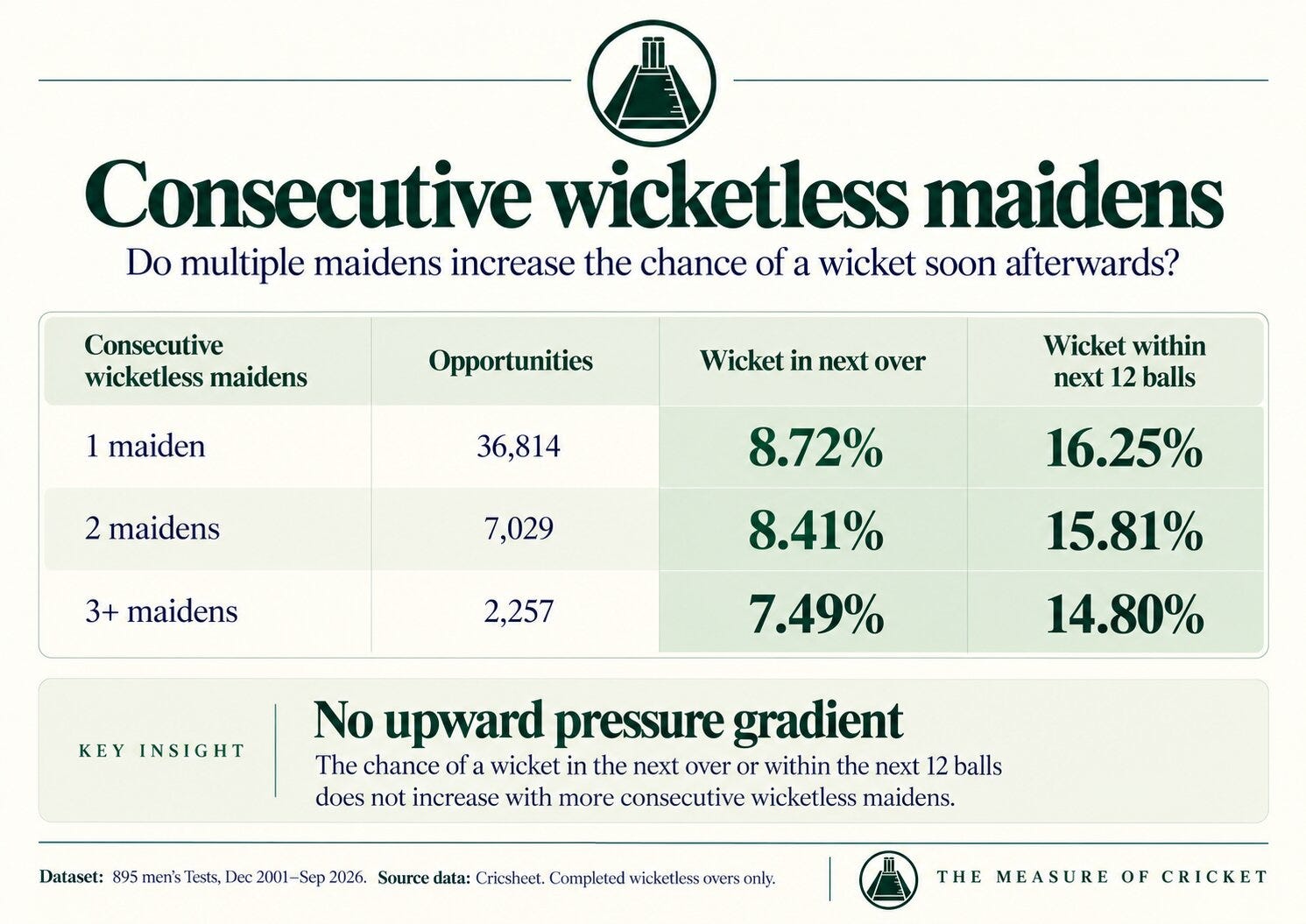
After a maiden over, there is an 8.72% chance of a wicket in the next over. After 3 or more consecutive maiden overs, the chances of a wicket falling in the next over drops to 7.49%. A similar pattern is evident when looking at the next 12 balls.
If anything, the data appears to show us that the chances of a wicket falling actually decrease with every wicketless maiden.
Adjusting slightly to look at the number of maidens in the previous 3 overs (even if maidens weren’t consecutive) shows the following:
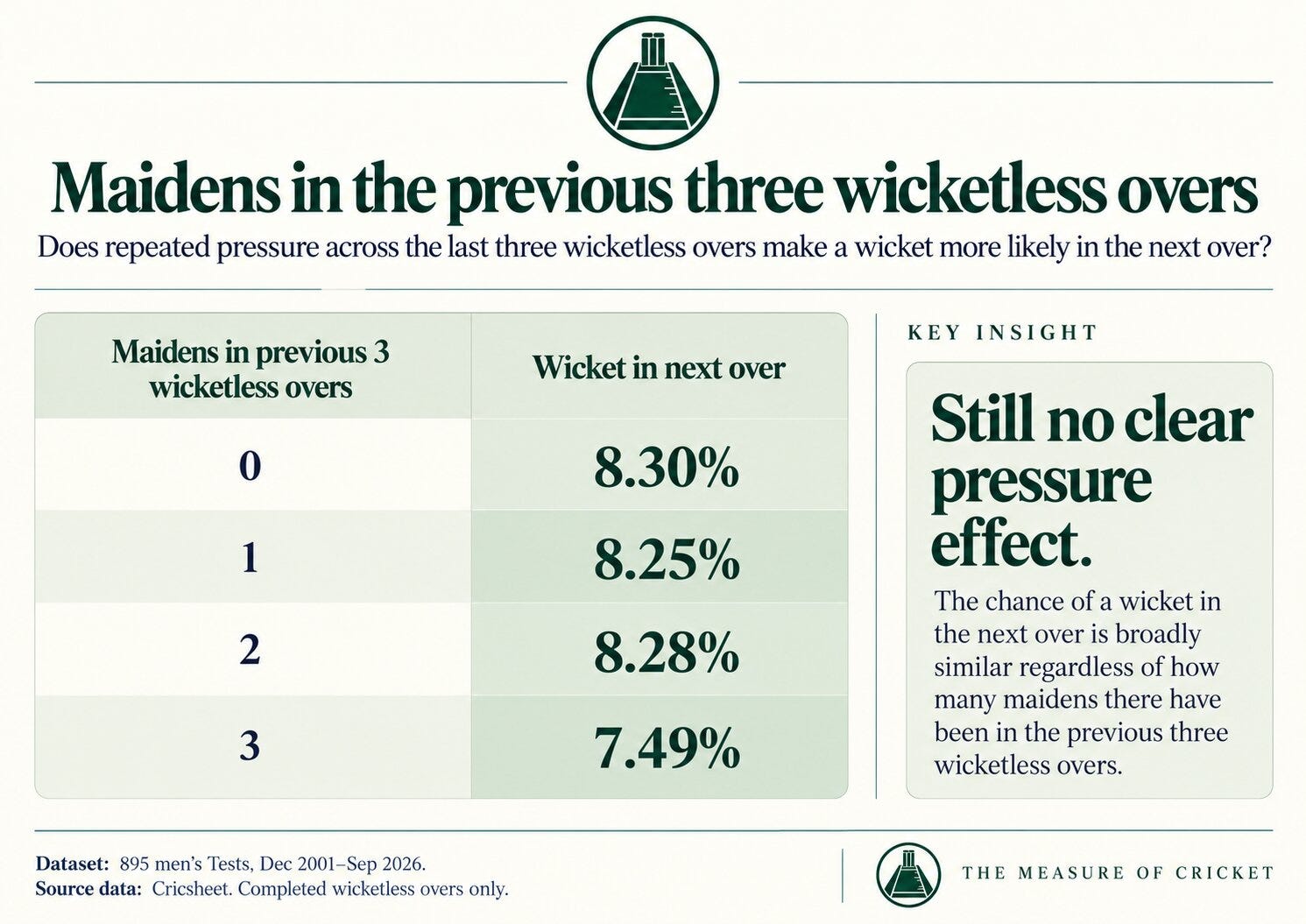
The findings here are pretty stark:
One maiden doesn't appear to create a wicket.
But I can take this further and say that:
Even sustained maiden pressure doesn't appear to make an immediate wicket more likely.
I’ve actually been very genuinely surprised by the results of my analysis here. Those results are, however, extremely clear. This is one example of where traditional, accepted cricketing wisdom does not appear to be supported by the data.
Thoughts On My Analysis
My analysis here didn’t produce the outcome that I probably expected. In such circumstances, I naturally find myself thinking about further research. In future, I’d be interested in taking a look at:
Whether my findings hold true across formats. I thought that this would particularly apply to Test cricket, but maybe it’s evident when looking at T20s, for example?
Whether there has been any change over time. I looked at the past 20 years of Test cricket. It would be interesting to compare my results here with earlier time periods
The impact of wicket-maidens. As I mentioned above, I very intentionally excluded them here. I felt that including them would skew the data, bringing into play the impact of another factor. But I’d like to re-run this analysis with them included, just to see what information that throws up