

Getting early runs on the board in Test cricket can sometimes feel like a real grind. The batsman is having to assess the conditions, playing themselves in. It can be a fight for survival.
Watching a batsman struggling early on in their innings, it can be hard to believe that they will soon be stroking the ball to the boundary, timing their shots so easily. Yet, fast forward a few hours and this often seems to be the case: once they reach 50, in particular, it feels like they grow in confidence. With the half century secured, they will accelerate from here. Or will they?
In this article, I take a closer look at the scoring rates of batsmen within Test cricket. Do they actually accelerate after reaching 50? Or might this just be a popular cricketing myth?
Do Test Centurions Score Their Second Fifty Faster Than Their First?
I looked at all Test matches played between December 2001 and September 2026. So my dataset here covers around 25 years of Test cricket. If batsmen truly do accelerate after reaching 50, then it seems to me that the data for those who go on to reach a century should be revealing: that second fifty should be scored a lot faster. But is it?
There have been 1,739 Test centuries during this period. The data tells us that nearly two-thirds of batsmen scored the second fifty in fewer balls than the first:
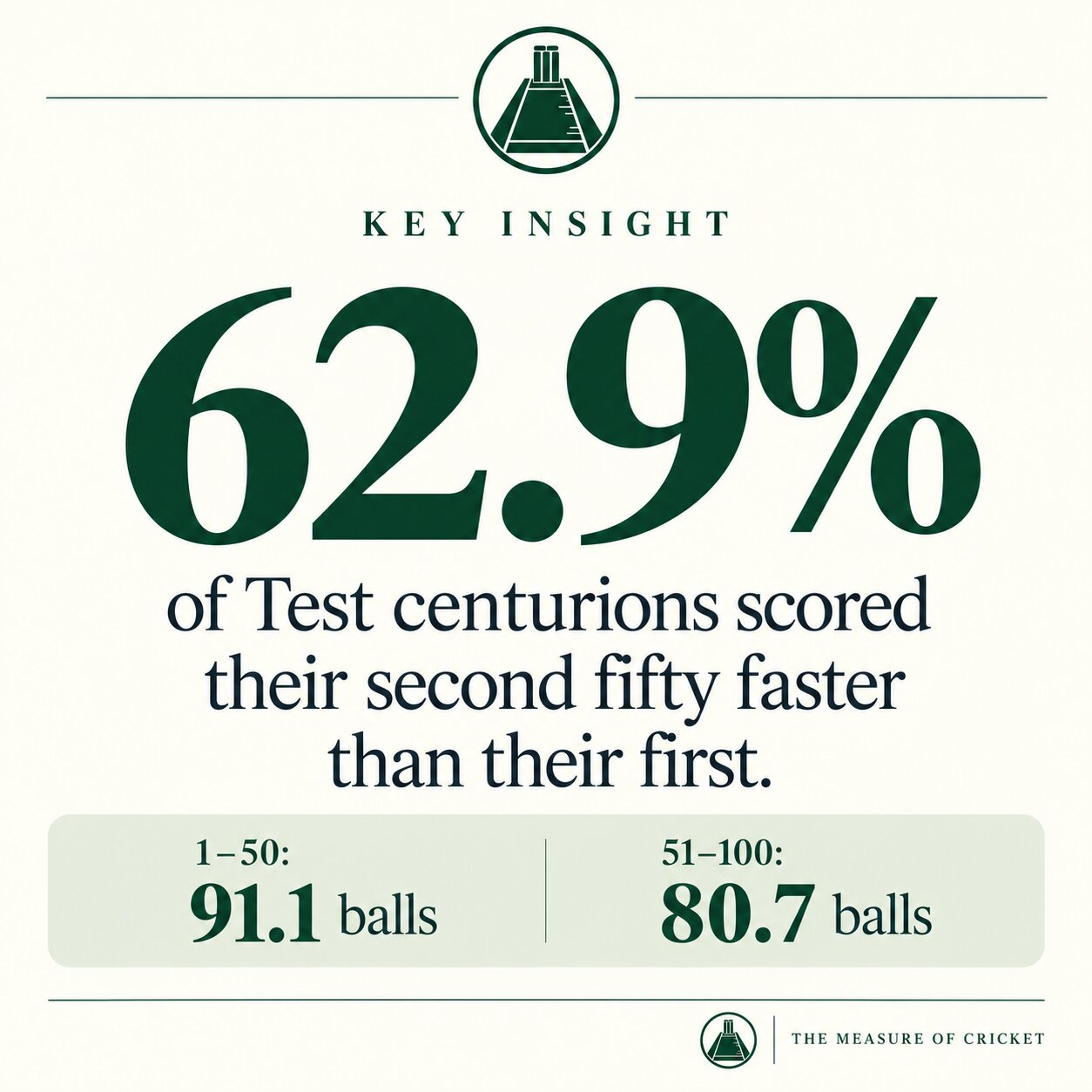
On average, it took them around 91 balls to reach that first 50, but only 81 more deliveries to go on from the half century to the century.
Job done, then: case proved! But I’m afraid this only tells part of the story. Much like a Test match itself, this is more of a marathon than a sprint.
What Happens When Batsmen Start In An Aggressive Manner?
Looking more closely at the data, I spotted something that offers a different spin on things: Test centurions usually do accelerate after fifty, but much of that acceleration comes from those who were relatively cautious getting there.
If I split the batsmen to have made centuries during this period into groups, based upon how quickly they made it to 50, then I see the following:
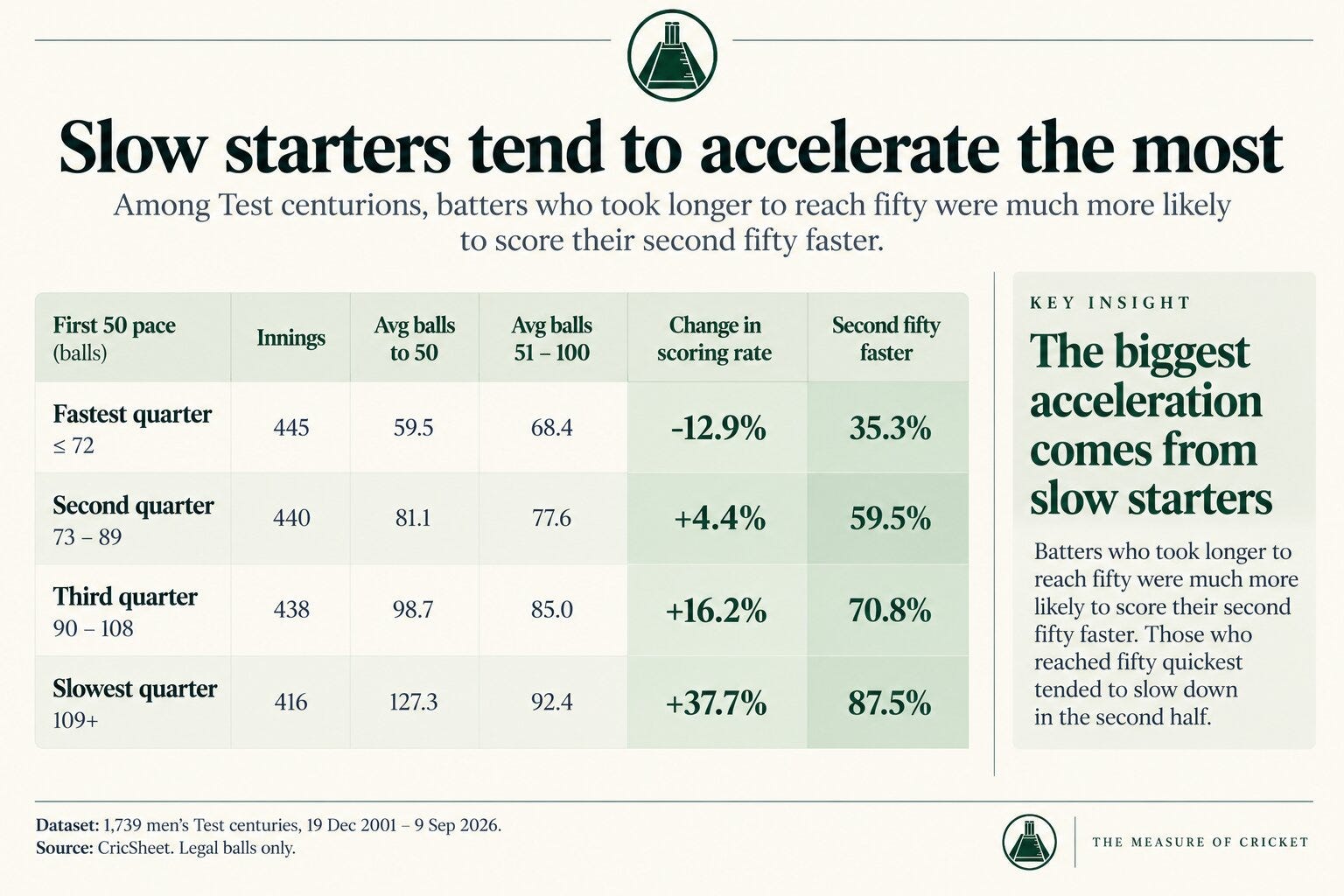
· The 25% of batsmen who made it to 50 fastest reached that milestone (on average) in 59.5 balls
· It took those batsmen (on average) a further 68.4 balls to make it to the century
· But, for the 25% of batsmen who made slowest progress to 50, they (on average) took 127.3 balls to reach the half century
· For this latter group, however, only 92.4 balls were required (on average) to move from 50 to 100
In other words, we can see a clear split:
· Those batsmen who start their innings fast and reach 50 quickly do typically slow their pace of scoring later in their innings
· Those who start slowly, taking their time to reach that first 50, can be seen to accelerate on to the century mark
What About Daddy Hundreds?
In the above analysis, I’ve considered batsmen who have scored centuries, looking at how their scoring rates changed after reaching their first 50. But what about those who go on to build huge scores?
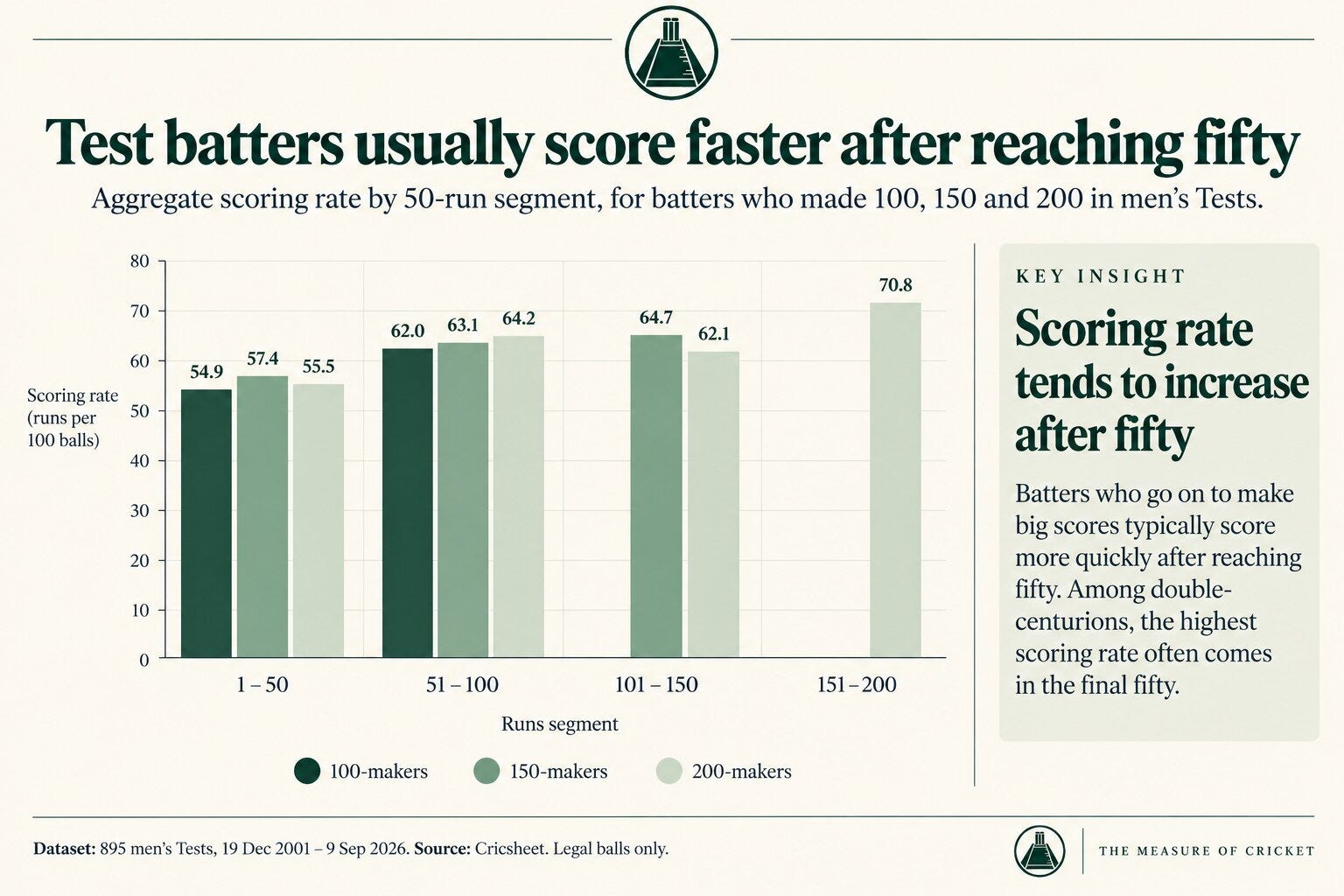
Within the dataset, I have been able to extract 503 scores of 150 or more. The rate of scoring here makes interesting reading:
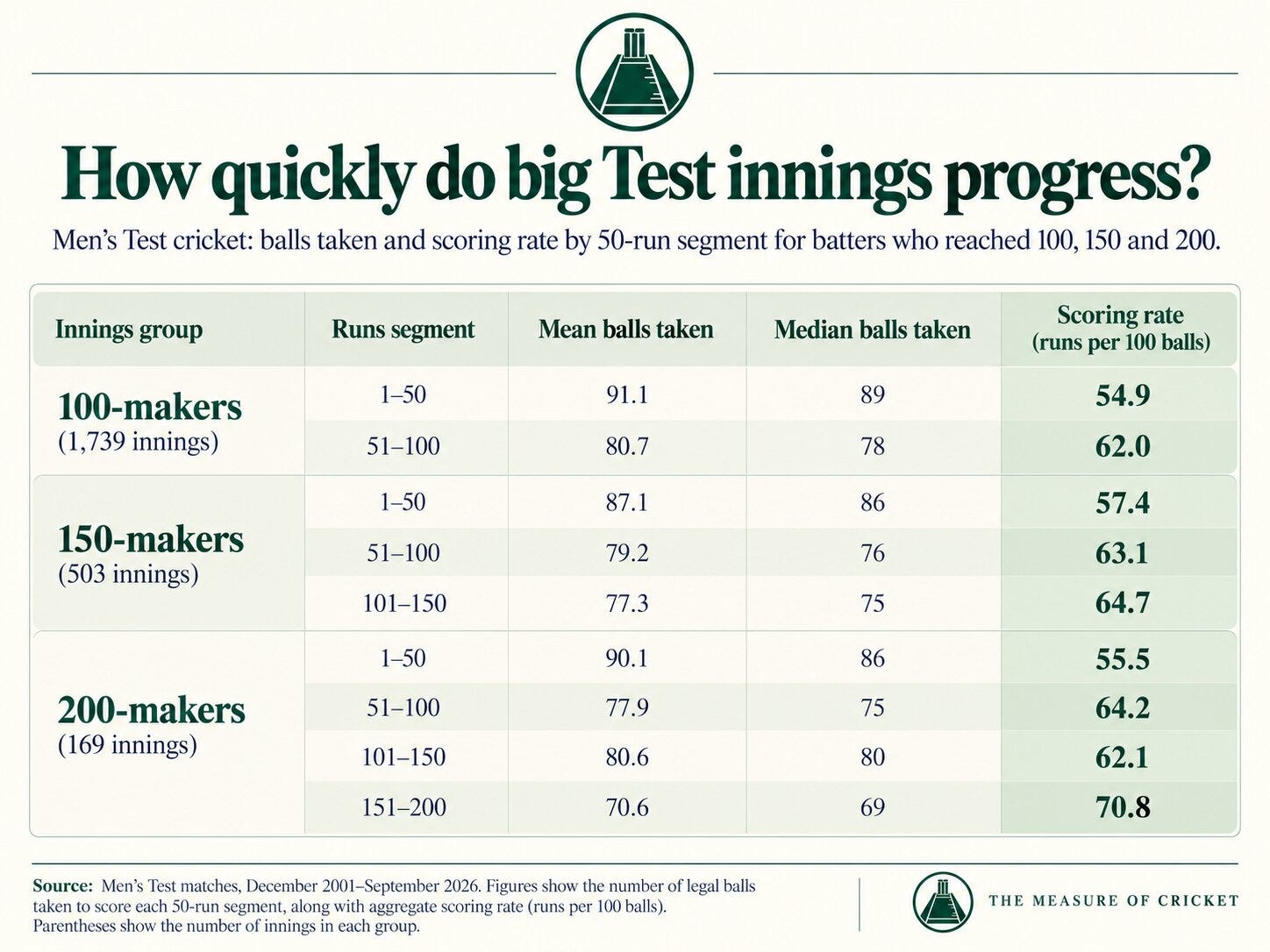
As we can see, those making 150 or more tend to see a continuous acceleration in their scoring: the second fifty was (on average) around 10% quicker than scoring rate than the first; the movement in their scoring from 101 to 150 was around 13% quicker than those first 50 runs.
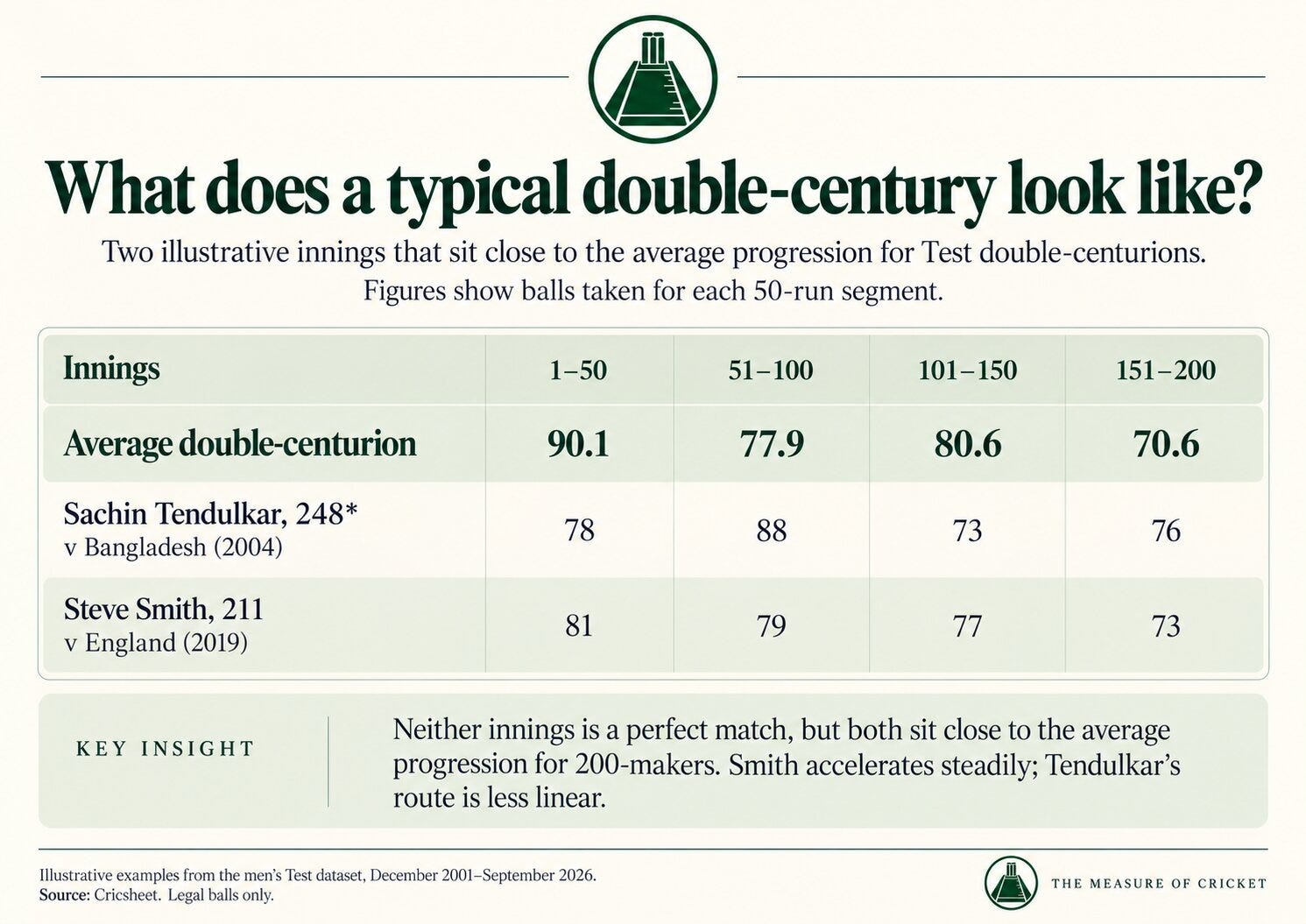
What about for those who go on to reach the milestone of a double century? As we would expect, this has been a relatively rare event. There are 169 double centuries in the past 25 years of Test cricket. Take a look at the scoring rates associated with these mammoth scores:
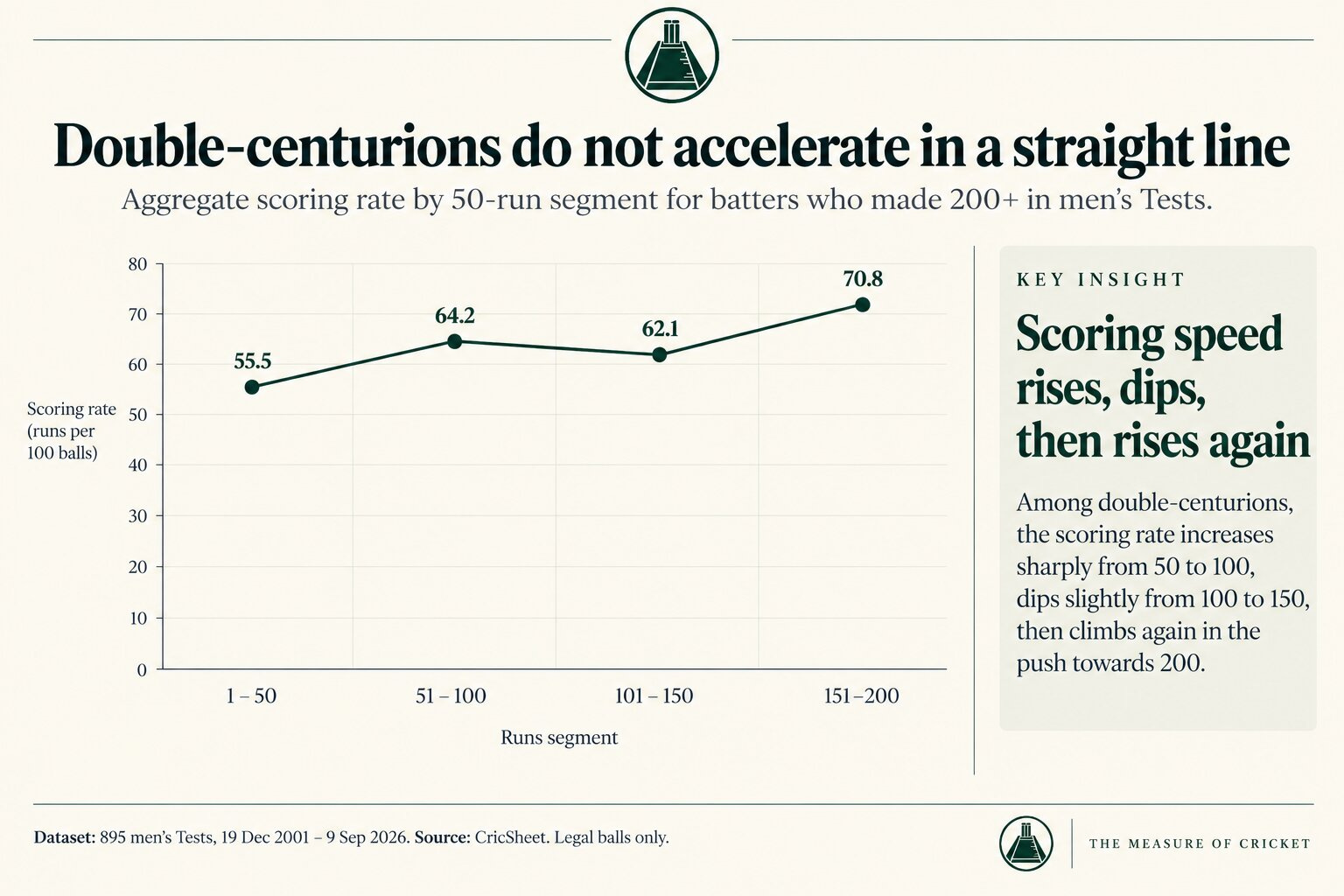
We can see that we’re not dealing with a straight-line acceleration here. In fact, the more common pattern associated with a double century appears to look like:
· A cautious start
· An acceleration up towards 100
· A slight consolidation from 100 to 150
· A strong acceleration from 150 to 200
At the innings level for double centurions, we can identify that:
· 68% of them scored 51-100 faster than 0-50
· Only 50.3% of them scored 101-150 faster than 51-100
· 65.1% of them scored 151-200 faster than 101-150
From what this shows us, it would appear that the average slowdown between 100 and 150 isn’t just being caused by a couple of extreme innings.
So, to return to the original question: do batsmen accelerate after reaching 50?
On the basis of this data, I would say that that they do indeed accelerate after reaching 50. But the story then becomes rather more nuanced: those who make big hundreds generally accelerate after 50, but the acceleration isn’t continuous. Double centurions often ease off somewhat after reaching 100, before accelerating markedly again beyond 150.
The Analysis Approach
For this analysis, I used ball-by-ball data from 895 men’s Tests between December 2001 and September 2026. I identified innings in which a batter reached 100, 150 or 200, then measured how many legal balls they took to score each successive 50-run segment (1–50, 51–100, 101–150 and 151–200).
I compared both the average and median balls taken, alongside the aggregate scoring rate for each segment. For the centurion analysis, I also grouped innings into quartiles according to how quickly the first fifty was scored, to see whether the subsequent acceleration differed between fast and slow starters.
The strength of this approach is its simplicity and scale: it compares different phases of the same innings, so much of the variation in player ability and match conditions is naturally held fairly constant.
However, it is descriptive rather than causal. By looking only at batters who went on to reach 100, 150 or 200, the sample is necessarily made up of successful innings, so the results should not be taken to mean that reaching fifty itself causes a batter to accelerate. The quartile analysis also contains some inevitable regression to the mean: unusually fast or slow first fifties are likely, to some extent, to be followed by more typical scoring rates.