


The first ball of a batsman’s innings can really lay down a marker for what is to come. He makes his way out from the pavilion, with a confident swagger. Standing with a sense of purpose at the crease, he’s prepared to do some real damage. Could this be make or break for both sides?
Is there a danger, however, that we place too much emphasis upon the supposed impact of the first ball? I’ve taken a look at One Day Internationals (ODIs) played in recent years, looking for examples where a batsman walks in and really gets off to a flyer. Indeed, I’ve examined some very extreme situations: those where an innings starts with a six.
For the bowling side, being hit for six straight away by a new batsman might seem like a real momentum shifter. It certainly wouldn’t be expected to be great for the confidence of the individual bowler concerned. But how much of an impact does it really have?
In this article, I take a look at those matches in which a six was hit off the first ball that a batsman faced. What happens next?
A Relatively Rare Occurrence
As a starting point, it’s worth stating that a six off a batsman’s first ball of an ODI innings is a pretty rare occurrence. At the time of writing, there have been more than 45,000 innings in this format. On how many occasions did the batsman start with a six? 125.
Of those 125 occasions, there were 10 instances where a batsman hit a six off their first ball and never faced another delivery (usually because it was the last ball of the innings).
What about the other 115 instances? Well, we can start by looking at the very next ball faced:
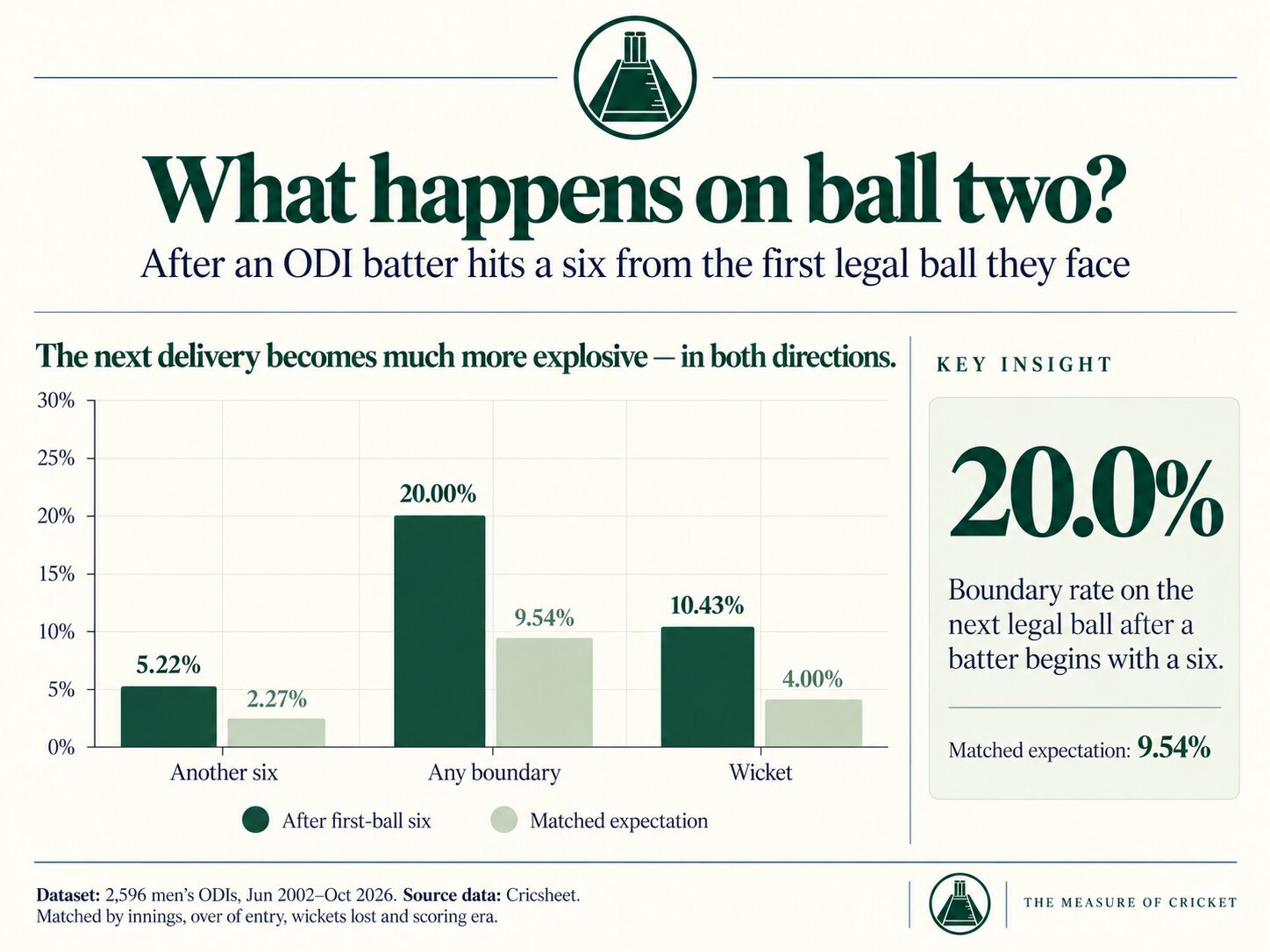
The second ball of the batsman’s innings becomes a lot more explosive, as we can see. There is a greatly increased chance of another six. But there’s also a big increase in their chances of getting out. Maybe that first six goes to their heads?
Is This Just Because They Arrived Late In The Innings?
If we look at our original 125 occurrences, then we find that 63 of them occurred at the death. Our raw data may thus be exaggerating the effect.
As we’ve seen in previous articles, it’s important to consider the state of the game. That’s going to give us a much more interesting comparison. In this case, I have taken into account comparable situations by innings, exact over, wickets lost and scoring era.
Why scoring era? In essence, scores have increased in ODIs over time. This means that sixes have become more commonplace, as have greater scores by individual players. So I’ve weighted the data to take this into account.

So what does the data tell us here? Even taking into account the match situation, it revels that a batsman hitting a six from the first ball is more than twice as likely to hit another six from the second ball that they face (when directly compared to a batsman failing to hit a six off their first ball).
Does The Fast Start Lead To A Bigger Innings?
After the opening six, how many more runs do batsmen go on to add?
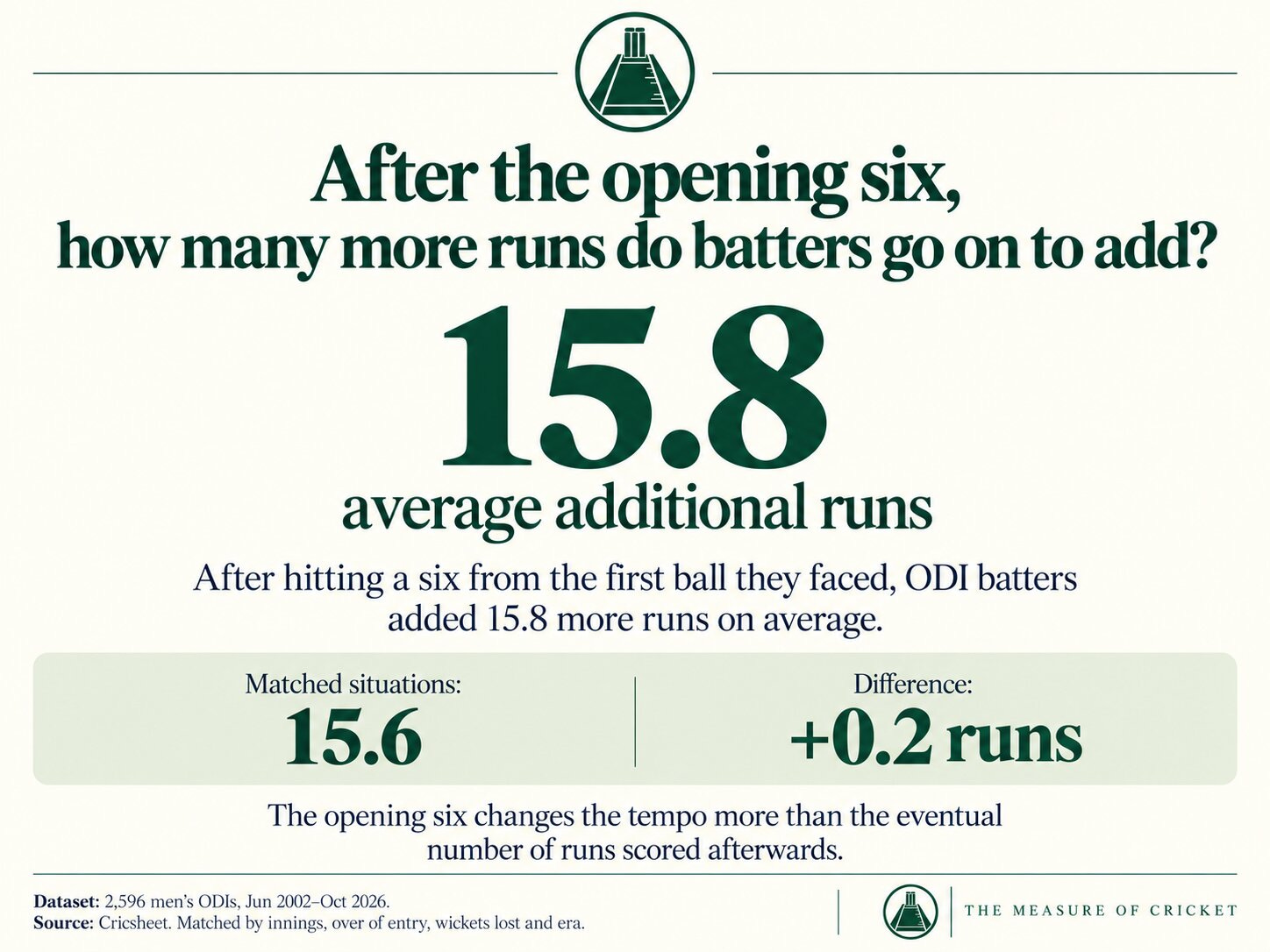
Interestingly, those who score a six off the first ball that they face go on to add an average of 15.8 further runs. Those who don’t score a six off the first ball that they face go on to add an average of 15.6 further runs. To all intents and purposes, that initial six makes almost no difference to what follows, in terms or runs to be added.
Is There A Relationship Between That Initial Six And Tempo?
After their first-ball six, batsmen scored at roughly 119 runs per 100 legal balls over the remainder of the innings. Comparable innings proceeded at roughly 92 per 100.
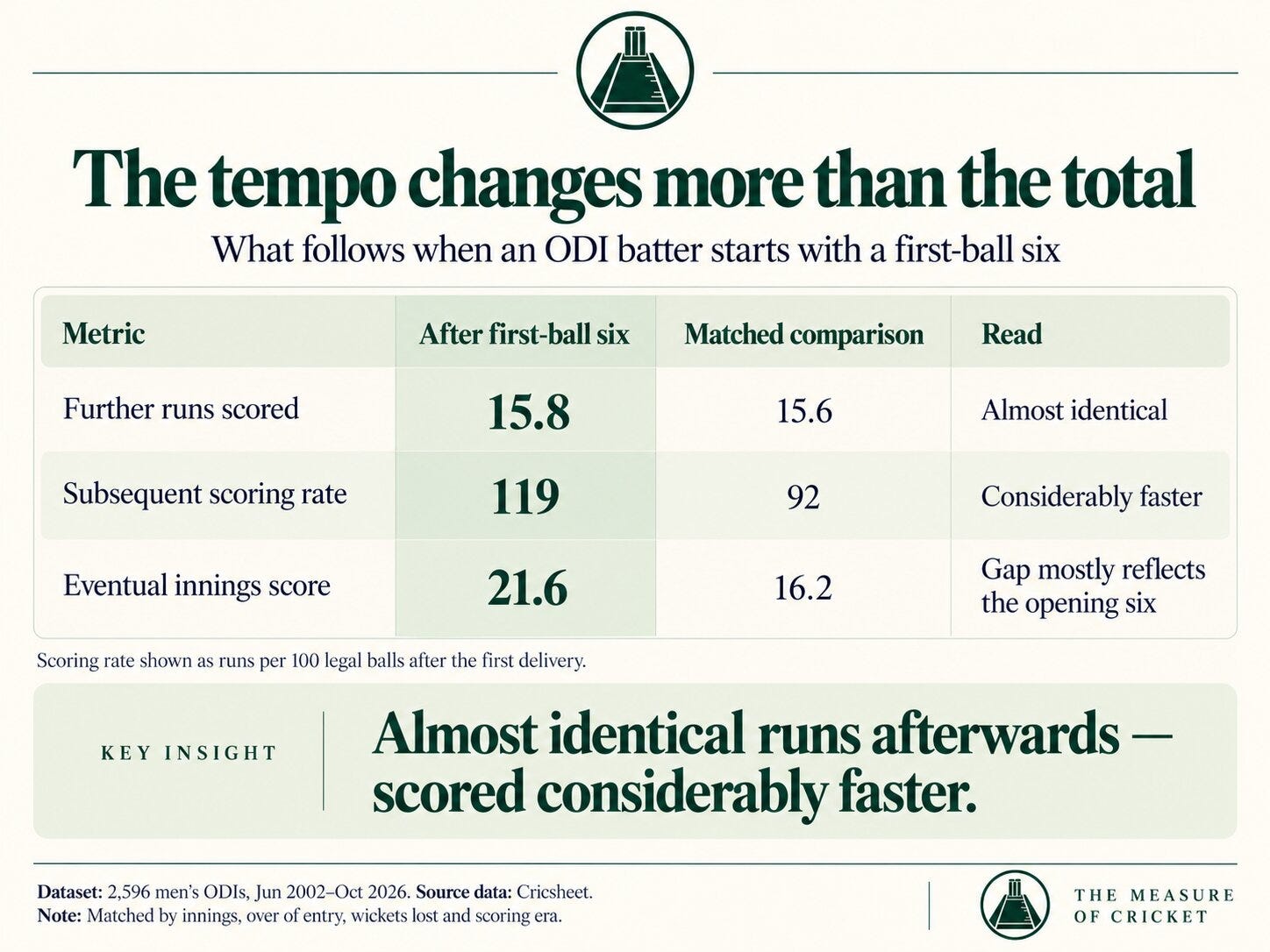
What we see, according to the data, is more attacking cricket, but greater dismissal risk.
What Can We Conclude?
A first-ball six appears to be a signal of intent rather than a route to a bigger innings. The batsman can be expected to continue more aggressively, produce more immediate boundaries, but they are also at greater risk of getting out. The tempo changes; the eventual run contribution barely does.